

NanoALi · Treatment comparison
NanoALi vs ligament repair or reconstruction
NanoALi may be used alone for a suitable continuous ligament injury or considered as a biological adjunct around repair. Surgery restores attachment or stability when the mechanical structure has failed.
 Reviewed byProfessor Paul Lee MBBch, FRCS (Tr & Orth), PhDCartilage and joint preservation expertise
Quick answer
The decision turns on continuity and stability. Stand-alone NanoALi may suit a viable partial or healing injury. A complete rupture or unstable joint may need surgery, with NanoALi biology considered separately to augment healing around the repair.
Verified across three networks
Trusted by patients on Doctify, Google and Top Doctors
The decisive distinction
Biological support and mechanical restoration solve different problems
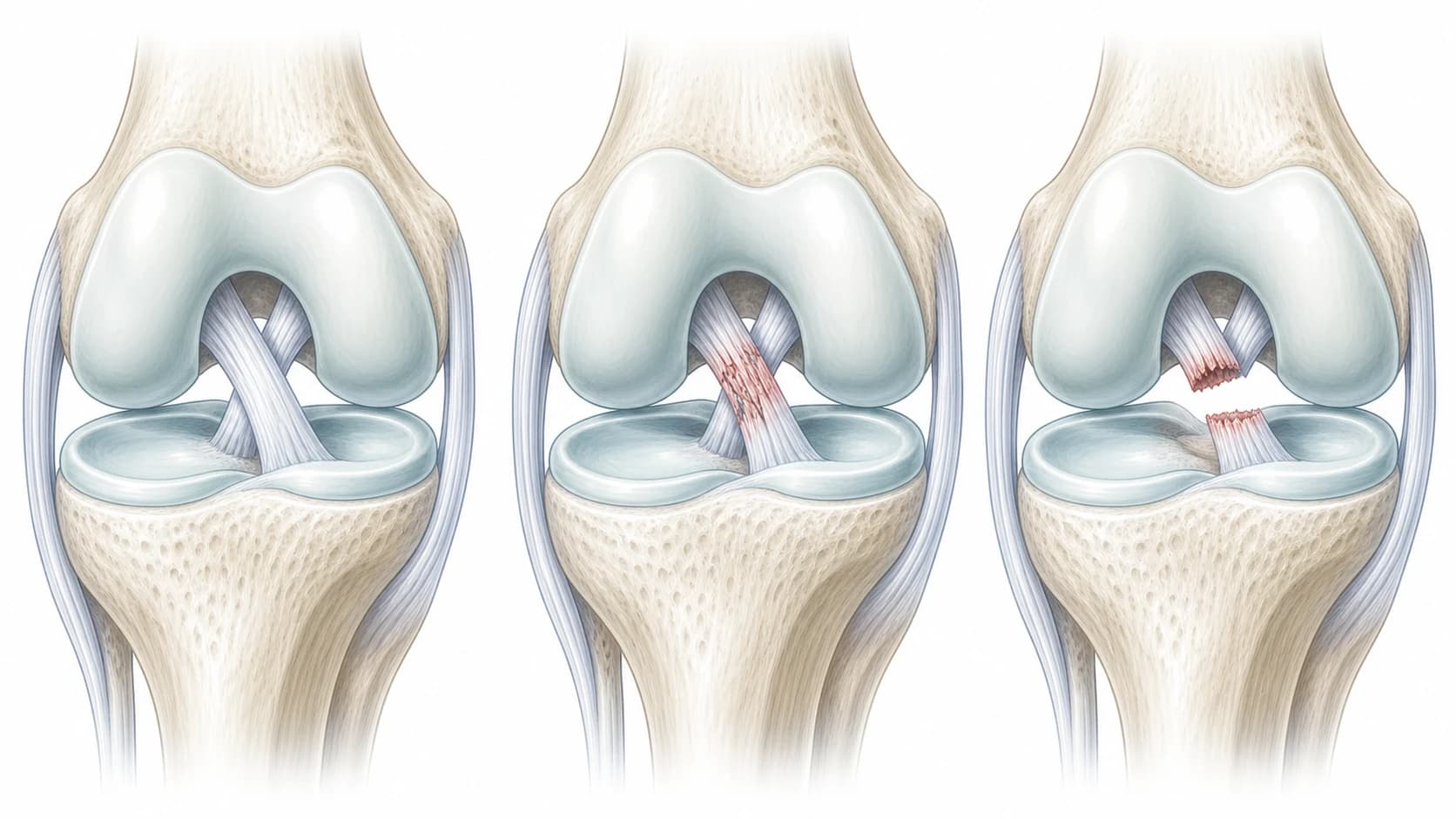
NanoALi may be considered where damaged ligament remains usefully continuous and the joint is stable enough for a non-operative pathway. Surgery repairs or reconstructs a structure when connection, attachment or stability must be restored.
The decision also considers which ligament is injured, acute or chronic timing, avulsion, associated injuries, recurrent giving way and the person's functional demand. When surgery is required, NanoALi biology may be considered separately to augment healing around the repair rather than to replace mechanical restoration.
When surgery becomes credible
Repair or reconstruction is about restoring stability
A repair preserves and reattaches suitable native tissue. A reconstruction replaces the failed ligament with a graft. Which is credible depends on the ligament, tear location, tissue quality, timing and joint mechanics.
Complete rupture does not automatically mean every patient has the same operation. Some injuries have structured non-operative routes, but that decision must explicitly manage rupture and instability rather than rename them as an injection indication.
Recovery trade-off
Both routes require staged mechanical rehabilitation
Surgery brings wound, fixation or graft-healing considerations. NanoALi avoids an operation but still needs protection, strength, proprioception and progression towards direction change.
The right route is the least invasive pathway that still solves the diagnosed structural problem—not automatically the injection or the operation.
Side-by-side
Support viable ligament or restore failed stability?
NanoALi and ligament surgery questions
Can NanoALi avoid surgery after a complete rupture?
NanoALi alone cannot reconnect a complete rupture. Some complete injuries have structured non-operative pathways; others need repair or reconstruction. Where surgery is required, NanoALi biology may be considered as an adjunct intended to support healing rather than replace the repair.
Does a partial ligament tear always need surgery?
No. Stability, ligament, tear location, associated injury, timing and response to rehabilitation all matter. Many partial injuries are managed non-operatively.
What is the difference between repair and reconstruction?
Repair preserves and reattaches suitable native tissue. Reconstruction uses a graft to replace the failed ligament. The available option depends on anatomy and timing.
Can a biological adjunct be used around surgery?
Yes. NanoALi biology may be considered within a separate surgical plan to augment healing around ligament repair or reconstruction. That is different from stand-alone, non-surgical NanoALi and must be explained as such.
Still have more specific concerns?
Free Discovery CallOptions that our doctors may discuss include NanoACi, ChondroFiller, Mytocel MSK, joint replacement, established conservative care or surgery, depending on examination and imaging.
Clarify continuity and mechanical stability
Professor Lee can define the ligament injury and explain proportionate rehabilitation, injection, repair or reconstruction options.